Iran warns Americans to ‘enjoy’ gas prices as Trump orders Hormuz ‘blockade’: LIVE UPDATES
Global oil prices have surged above $100 after the US Department of War announced that American forces will begin enforcing a blockade on all maritime traffic entering and exiting Iranian ports from 10 am ET (2 pm GMT) on April 13.
US Central Command said the blockade would apply to vessels of all nations calling at Iranian ports on the Arabian Gulf and Gulf of Oman, but insisted that it would not impede freedom of navigation through the Strait of Hormuz for ships travelling to and from non-Iranian ports.
Global oil prices soared past $100 a barrel after the announcement, as Iranian Parliament Speaker Mohammad Bagher Ghalibaf warned Americans to “enjoy” current prices at the pump, adding that “soon you’ll be nostalgic for $4–$5 gas.”
President Donald Trump has previously threatened to deny “safe passage” to any ships that have complied with Iran’s transit rules.
Iran, for its part, has warned that any hostile military activity in the waterway will be met with force, even as President Masoud Pezeshkian has said a deal would still be possible if Washington abandoned what he called “totalitarianism.”
Key developments:
- After the collapse of marathon 21-hour negotiations in Islamabad, Vice President J.D. Vance said Washington had left Pakistan with its “final and best offer” still on the table, while Tehran said the process broke down because of “excessive” or “unreasonable” American demands.
- The main sticking points remain the same: Iran’s nuclear program, the future of the Strait of Hormuz, sanctions relief, war compensation, and the wider regional conflict. Washington has framed the impasse around its demand for a binding commitment that Iran not pursue a nuclear weapon, while Iranian officials say the US tried to win at the negotiating table what it failed to secure during the war.
- Iranian Foreign Minister Abbas Araghchi said the Islamabad talks came within “inches” of reaching a memorandum of understanding before the process was derailed by “maximalism, shifting goalposts, and blockade.”
Follow our live coverage below for continuous updates. You can also read our previous updates here.
13 April 2026
00:10 GMTActing Deputy Attorney General Todd Blanche says the US will “vigorously prosecute” anyone involved in buying or selling sanctioned Iranian oil.
The Department of Justice will vigorously prosecute anyone who buys or sells sanctioned Iranian oil.@TheJusticeDept fully supports our Commander in Chief @POTUS and our military. https://t.co/ncwnn039AV
— Acting AG Todd Blanche (@DAGToddBlanche) April 12, 202612 April 2026
23:57 GMTSeyed Hossein Mousavian, who previously served on Iran’s nuclear diplomacy team, says the failed Pakistan talks still showed that a diplomatic channel remains open between Tehran and Washington.
“No one expected a big deal in Pakistan after 40 days of war. Nevertheless, it was high-level direct negotiations, and they can continue to resolve the two remaining issues,” Mousavian told Al Jazeera.
According to Mousavian, the two main sticking points are now clear: freedom of navigation in the Strait of Hormuz and Iran’s nuclear enrichment. “I believe there is a solution for both,” he said, suggesting that despite the deadlock in Islamabad, there is still room for further negotiations.
The Islamabad Talks is "not an event but a process." The Islamabad Talks laid the foundation for a diplomatic process that, if trust and will are strengthened, can create a sustainable framework for the interests of all parties. I would like to express my gratitude to the… pic.twitter.com/qzCb1xYzPh
— Reza Amiri Moghadam (@IranAmbPak) April 12, 2026- 23:35 GMT
Besides the announced US blockade targeting Iranian ports and traffic around the Strait of Hormuz, Trump is considering resuming “limited” strikes against Iranian infrastructure, the Wall Street Journal has reported, citing sources.
The US president has also not ruled out a broader bombing campaign, though officials say that is less likely because of the risk of wider regional destabilization and his reluctance to enter a prolonged conflict.
“I would hate to do it, but it’s their water, their desalination plants, their power plants, which are very easy to hit,” Trump told Fox News earlier on Sunday.
A White House spokesperson declined to detail specific plans, saying the president “keeps all additional options on the table” and dismissing reports about his next steps as speculation.
- 23:05 GMT
Australia has signaled it is not preparing to join the US naval blockade around Hormuz, with Prime Minister Anthony Albanese saying Canberra has not been asked to take part and ministers stressing that diplomacy remains the best path forward.
“We haven’t been asked to participate. We’ve received no requests. We haven’t been asked … and I don’t expect that we will be,” Albanese told local media.
- 22:59 GMT
Former EU foreign policy chief Federica Mogherini, who helped steer the 2015 Iran nuclear deal, has warned against expecting any quick breakthrough between Washington and Tehran after the failed Islamabad talks.
“It took us 12 years and an immense amount of technical work, anyone seriously thought an agreement could be reached in 21 hours….?” Mogherini wrote in a post on X.
The Joint Comprehensive Plan of Action, reached in 2015, was negotiated between Iran and the E3/EU+3 – China, France, Germany, Russia, the United Kingdom and the United States, with the EU coordinating the process – and was designed to keep Iran’s nuclear programme exclusively peaceful in exchange for sanctions relief. The US unilaterally withdrew from the deal in 2018 during Trump’s first term.
It took us 12 years and an immense amount of technical work, anyone seriously thought an agreement could be reached in 21 hours….? #Jcpoa#Iran
— Federica Mogherini (@FedericaMog) April 12, 2026 - 22:42 GMT
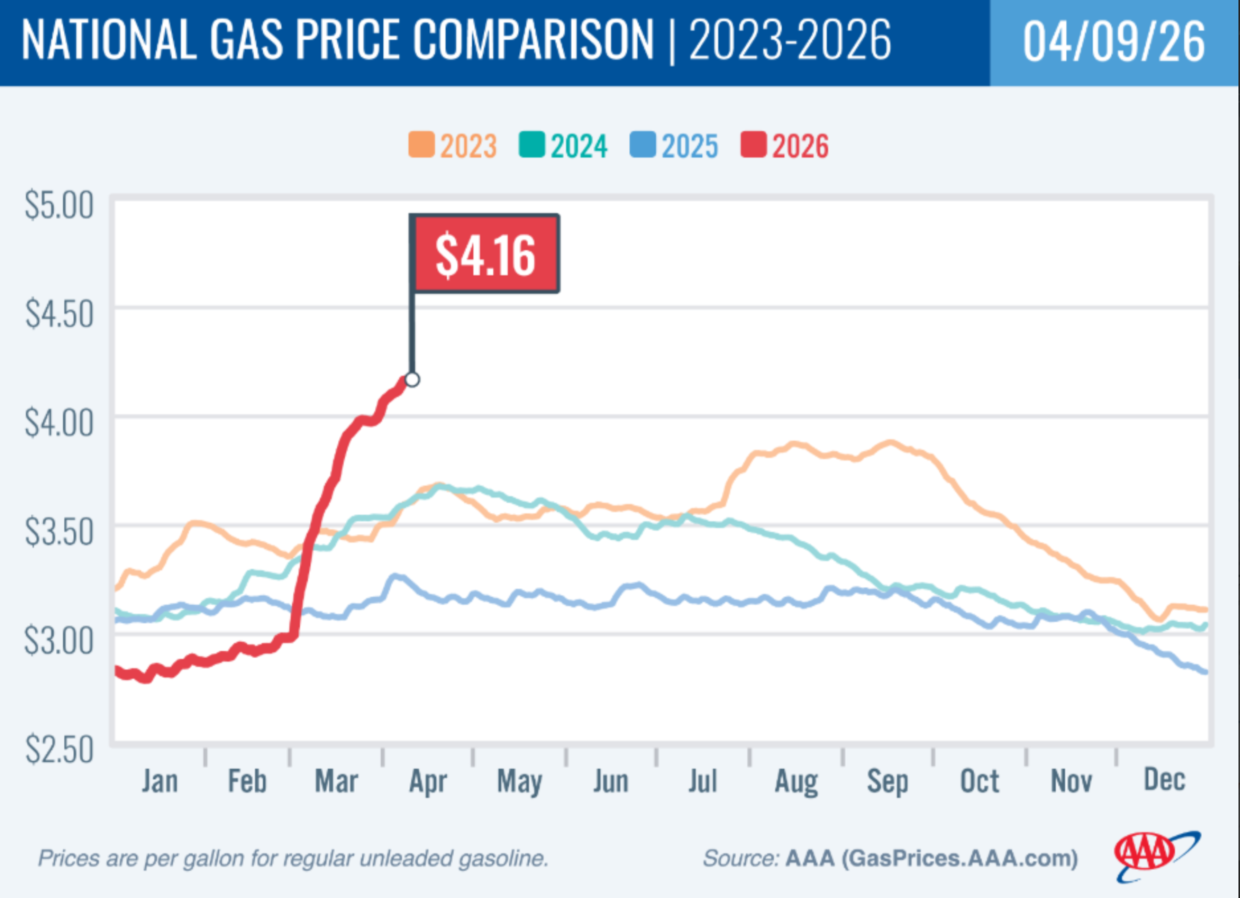
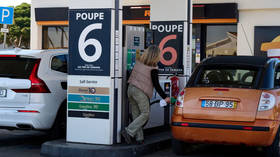
US gasoline prices have surged since the late-February attack on Iran, with the conflict disrupting global oil supplies and forcing American drivers to cut back on spending.
Fuel costs have climbed above $4 per gallon nationwide, rising by roughly 25% to 30% over the past month, with the national average reaching about $4.16, up around 8 cents in a week.
Global crude markets remain highly volatile, with prices swinging more on Trump’s rhetoric than on developments on the ground, where a tentative ceasefire continues to hold despite the collapse of talks.

- 22:12 GMT
Oil prices have jumped sharply after the Pentagon announced a US naval blockade targeting Iranian ports, with fresh fears of disruption around the Strait of Hormuz jolting energy markets.
Market screens showed WTI crude up 8.41% to $104.69 and Brent up 7.46% to $102.30, pushing the global benchmark back above the $100 mark.
- 22:03 GMT
Iranian Parliament Speaker Mohammad Bagher Ghalibaf mocked Donald Trump’s blockade threat by warning American drivers that fuel prices could soon surge far beyond current levels.
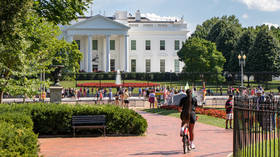
“Enjoy the current pump figures. With the so-called ‘blockade’, Soon you’ll be nostalgic for $4–$5 gas,” Ghalibaf wrote in a post on X, sharing a map of gas prices near the White House.
Enjoy the current pump figures. With the so-called 'blockade', Soon you'll be nostalgic for $4–$5 gas.ΔO_BSOH>0 ⇒ f(f(O))>f(O) pic.twitter.com/rVxlC6vFWG
— محمدباقر قالیباف | MB Ghalibaf (@mb_ghalibaf) April 12, 2026 - 21:52 GMT
Iranian Foreign Minister Abbas Araghchi says Tehran engaged “in good faith” in the Islamabad talks and came within inches of an “Islamabad MoU” before the process was derailed by “maximalism, shifting goalposts, and blockade.”
“Good will begets good will. Enmity begets enmity,” he added in a pointed warning to Washington.
In intensive talks at highest level in 47 years, Iran engaged with U.S in good faith to end war.But when just inches away from "Islamabad MoU", we encountered maximalism, shifting goalposts, and blockade. Zero lessons earnedGood will begets good will. Enmity begets enmity.
— Seyed Abbas Araghchi (@araghchi) April 12, 2026 - 21:48 GMT
Iran’s embassy in Thailand has mocked President Trump’s decision to blockade the Strait of Hormuz in order to free the waterway as “comical”.
“The new move from Trump against our country is so comical that we don’t even have a meme for it,” the mission said in a post on X.
The new move from trump against our country is so comical that we don't even have a meme for it.
— Iran Embassy in Thailand ☫ (@IranInThailand) April 12, 2026